Halloween Music History: “Thriller”
This post is part two of a three-part series and extension of “A Brief History of Halloween Music” in the 2026 fall issue of Spooky Little Halloween—The Magazine.
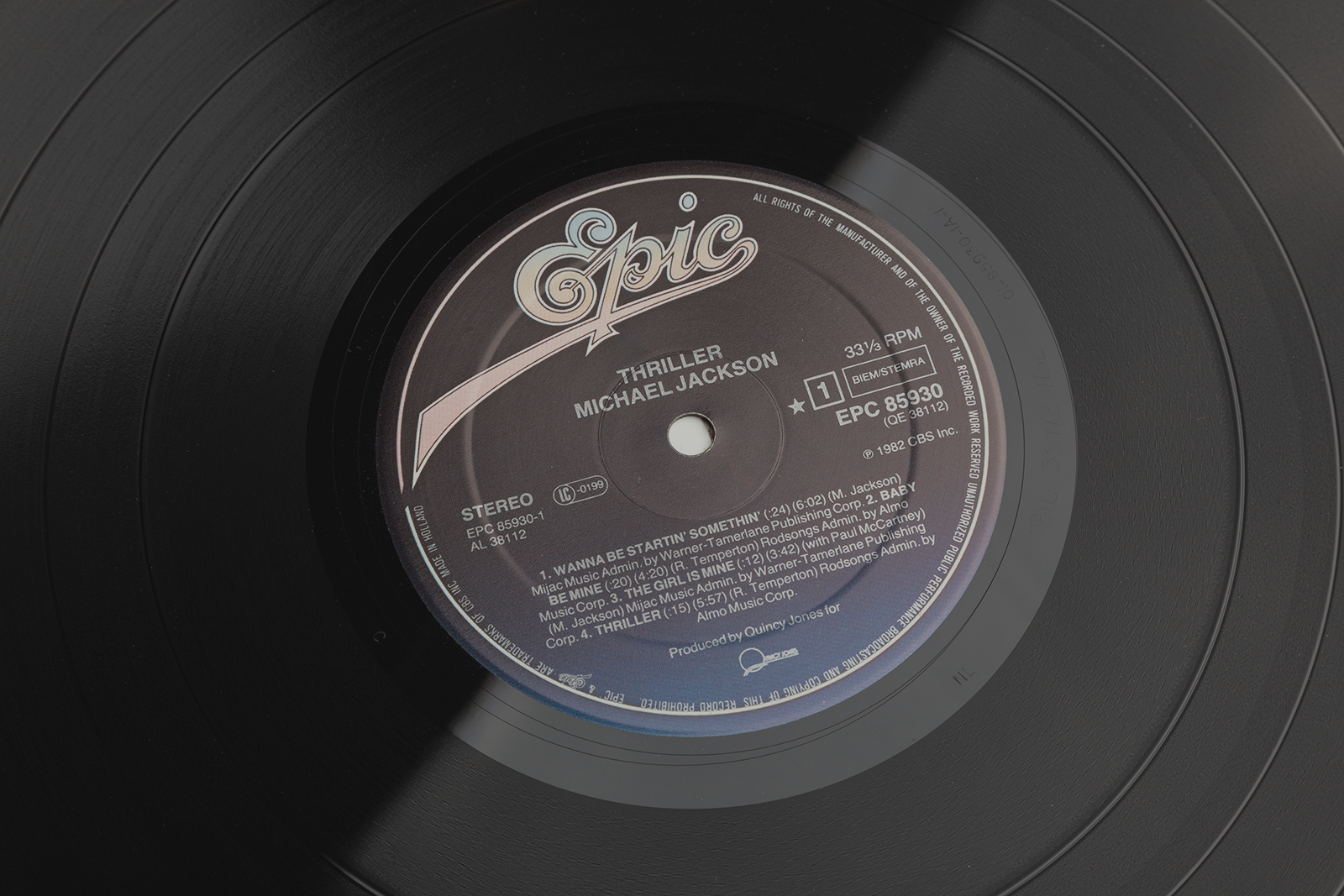
By the summer of 1983, Michael Jackson's Thriller had already spent months at the top of the Billboard 200, spun off two massive singles in "Billie Jean" and "Beat It," and quietly become the bestselling album in America.
Then it slipped. Flashdance knocked it off the top spot, and Jackson's team needed a way to climb back.
Their solution was a horror-themed deep cut nobody at the label particularly wanted as a single. The 13-minute short film built around it would end up doing more to define Halloween than almost anything released specifically for the holiday.
Here's the full story of how that happened.
The setup
"Thriller" wasn't written with Halloween, or even horror, specifically in mind at first. Songwriter Rod Temperton — who'd already given Jackson "Rock with You" and "Off the Wall" — originally titled the track "Starlight," with a hook that went "starlight, starlight sun." Producer Quincy Jones liked the direction but wanted something more atmospheric to match Jackson's ‘evolving persona.’
Temperton tried a few hundred alternatives, landed briefly on "Midnight Man," then woke up one morning with a single word in his head: "Thriller." He initially worried it was "a crap word to sing," but once Jackson spat it into the microphone a few times, it worked.
With the title locked in, Temperton wrote the lyrics in a couple of hours, building in horror-movie sound design — creaking doors, thunder, and howling wolves. Jackson himself ended up providing the howls after an overnight attempt to record engineer Bruce Swedien's dog produced nothing usable.
Temperton also wanted a spoken-word section at the end, performed by "somebody, a famous voice, in the horror genre." Quincy Jones's then-wife, Peggy Lipton, happened to know Vincent Price and suggested him for the part.
The making
Temperton wrote Price's now-iconic rap — "Darkness falls across the land, the midnight hour is close at hand..." — in a taxi on the way to the studio, the same day Price was scheduled to record it. Price, who'd never used studio headphones before and was visibly startled when the funky track first hit his ears, nailed the part in two takes.
Quincy Jones, who knew firsthand how difficult voiceover work could be, called the result "fabulous." Price chose a flat $20,000 fee over a percentage of the album's proceeds; Thriller went on to sell over 100 million copies worldwide. Asked about it years later on The Tonight Show, Price just laughed: "How well I know!"
Even with the song finished, Epic Records initially balked at releasing "Thriller" as a single. Executive Walter Yetnikoff reportedly asked, "Who wants a single about monsters?" By mid-1983, though, Thriller's sales were sagging, and Jackson's team decided a fourth video, built around the title track, might be worth the risk.
What they made was nothing like a typical music video. Jackson had been captivated by John Landis's 1981 film An American Werewolf in London and called Landis directly, asking him to turn "Thriller" into something closer to a short film.
Landis agreed, on the condition it be shot like an actual movie — 35mm, full production values, a real plot. The budget ballooned to roughly $1 million, an unheard-of sum for a music video, and CBS Records refused to pay for it outright. Landis and producer George Folsey Jr. solved the shortfall by filming a behind-the-scenes documentary, Making Michael Jackson's Thriller, and pre-selling the broadcast rights to MTV and Showtime for a combined $500,000.
The finished film ran nearly 14 minutes: Jackson and his date (Ola Ray) leaving a movie theater, a transformation into a werecat designed by makeup artist Rick Baker, and an elaborate zombie graveyard dance choreographed by Michael Peters. Because Jackson was a devout Jehovah's Witness, and the religion's elders threatened to excommunicate him over the film's "demonology," a disclaimer was added at the last minute assuring viewers it did not endorse a belief in the occult.
The reception
"Michael Jackson's Thriller" premiered on MTV on December 2, 1983, to an audience the network had specifically built anticipation for in advance.
It worked spectacularly: the video doubled Thriller's weekly sales, helping push the album to its eventual status as the bestselling record of all time, and the Making of documentary became the bestselling home video release in the format's history at that point. The red leather jacket Jackson wore, designed by Landis's wife Deborah Nadoolman, became an instant fashion icon — one of the two original jackets later sold at auction for $1.8 million.
Not every reaction was admiring. Roger Ebert and Gene Siskel both gave the video a "thumbs down" for leaning on tired horror tropes, and in 1984 the National Coalition on Television Violence classified the video as one of the most violent items it reviewed on MTV that year, with its chairman warning that the imagery risked normalizing real-world aggression.
Jackson lost the MTV Video of the Year award that year to the Cars' "You Might Think," though "Thriller" did pick up Best Choreography and the Viewer's Choice award.
The legacy
What "Thriller" actually changed wasn't really about Halloween at first — it was about what a music video could be.
Before "Thriller," videos were treated largely as disposable promotional tools; afterward, the format was widely understood to be capable of cinematic ambition, narrative complexity, and serious craft. Directors like Spike Jonze have pointed directly to "Thriller" as the moment that convinced an entire generation of filmmakers that music videos were worth taking seriously as an art form.
The video is also credited with helping break down racial barriers on MTV, a network that had been criticized up to that point for largely excluding Black artists from rotation. In 2009, the year of Jackson's death, the Library of Congress inducted "Michael Jackson's Thriller" into the National Film Registry — the first music video ever to receive that honor, recognized for its "cultural, historical, and aesthetic" significance.
It's been named the greatest music video of all time by MTV (1999), VH1 (2001), and Time (2011), and crossed one billion YouTube views in 2024.
Its connection to Halloween specifically grew almost as an afterthought of timing. The video happened to premiere in December, attached to a song about monsters, and it simply stuck to the holiday from there.
The zombie dance gets reenacted at Halloween parties and flash mobs every year; it's shown up everywhere from prison yards in the Philippines (1,500 inmates performing the choreography in matching uniforms went viral) to the 2026 Michael Jackson biopic, which restages the video's production in detail.
Vincent Price, who recorded his part in two takes for a flat fee he later laughed about, died on October 25, 1993 — almost exactly 10 years, to the week, after the song he's most remembered for first aired.
Of the three songs in this series, "Thriller" is the one that didn't start out trying to be a Halloween song at all. It became one anyway, mostly by being too good, too expensive, and too strange to be anything else.

Sources: Thriller (song) — Wikipedia, Michael Jackson's Thriller (music video) — Wikipedia, Rod Temperton — Wikipedia, No Mere Mortal: Vincent Price and Michael Jackson's Thriller — Legacy.com, 42 Years Ago, Michael Jackson's First Major Controversy Ended Up Changing The Music Industry Forever — ScreenRant, Michael Jackson: Behind the Scenes of His Iconic 'Thriller' Music Video — Biography.com, Michael Jackson's Thriller (Music) — TV Tropes, 30 Years On: Michael Jackson's 'Thriller' Video — Tone Deaf, Vincent Price Chose $20,000 Dollars Over a Percentage of Michael Jackson's THRILLER Album Proceeds — GeekTyrant, By: Rod Temperton — Thriller40.com